
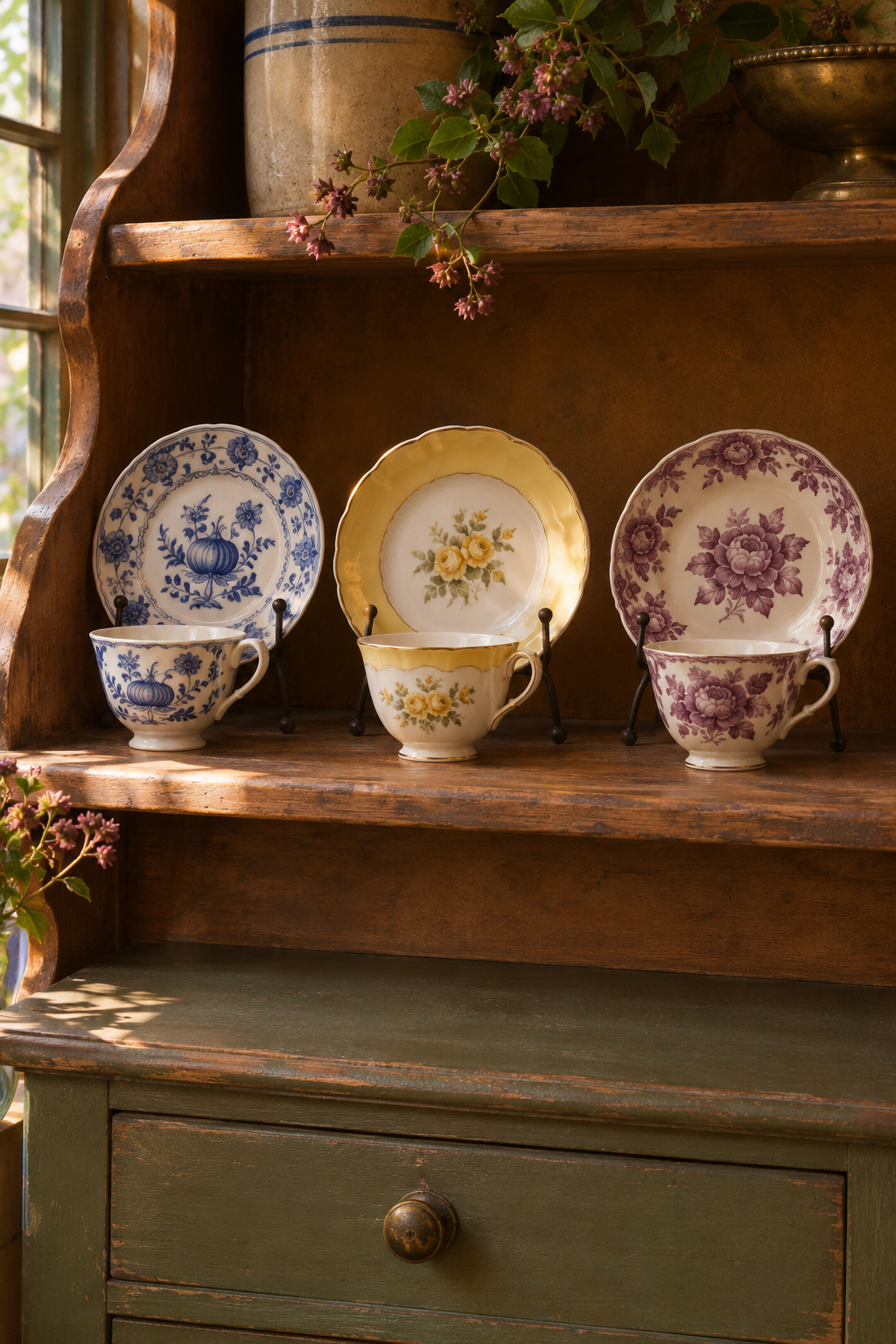
Sometimes the prettiest part of a thrifted tea set is the little spray of flowers right where the cup sits. For a set you want to see every day, give the saucer its own stand and move the cup a little to one side. For the pair you take down for tea, keeping the two nested makes more sense. Both arrangements can live on the same shelf.
As an Amazon Associate I earn from qualifying purchases. The image is an AI-generated styling illustration.
Start with the saucer you’d most like to see
Measure straight across the widest part, including any scalloped edge. Check the plate diameter a stand is designed to hold. A number in the product title can also be the height of the stand itself. For example, Tripar calls its small Classic a 4½-inch stand and lists it for pieces 3 to 6 inches across. A 5½-inch saucer is inside that range. A 6½-inch saucer calls for a different size. Check Tripar’s small Classic plate stand specifications.
See if the cup and stand will share the shelf
Cut a strip of paper to the usable shelf depth. If it’s a glass-front hutch, measure to the inside of the closed door. On a table, set an open stand and saucer at the back of the paper and place the cup in front, handle turned as you’d display it. Check that every stand foot and the full cup base sit inside the strip. Leave space between the two pieces so the cup doesn’t tap the saucer when you lift it.
On a shallow shelf, slide the cup beside the stand. That usually reveals more of the pattern, too. With very little width, set the cup on its saucer and display one spare patterned saucer upright in the next opening. If your hutch already has a plate groove, try one saucer there first and check that it sits securely when you open and close the door.
Give the patterns some room
A blue transferware pair, a yellow-rimmed pair and a plum floral pair can share a row without matching. I’d turn each saucer until its main motif sits above the cup, then step back to the doorway. If all you see are handles, turn just the middle cup. One small change is often enough to make the row readable.
If you need stands for a collection, start with one and test it with your most curved saucer before ordering multiples. The lower lip needs to accommodate the curve of the dish, and the back support should meet it without forcing it forward. Browse small saucer display stands on Amazon (paid link).