
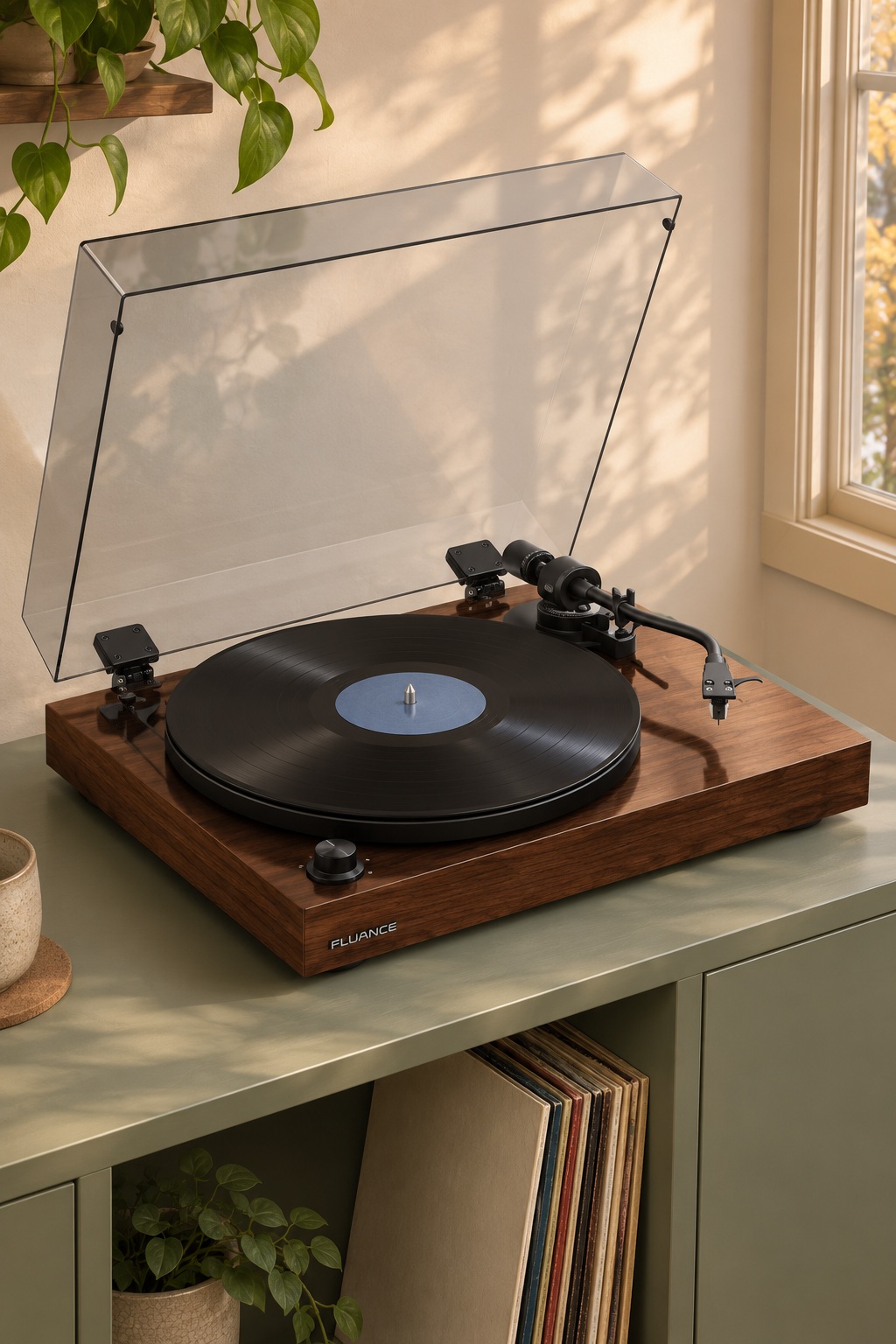
The Fluance RT82 needs a phono preamp somewhere in the signal chain. It has no built-in preamp. If your receiver or powered speakers already have a compatible PHONO input, that input supplies what the turntable needs. Check the label on the back of your gear before adding a standalone preamp to your cart.
As an Amazon Associate I earn from qualifying purchases.

Three ways to connect the RT82
- Receiver with PHONO: Connect the RT82 to that input and use the receiver to drive your passive speakers.
- Powered speakers with PHONO: Connect directly to their phono input.
- Powered speakers or receiver with only AUX/LINE: Put a separate moving-magnet phono preamp between the turntable and that input.
What to check before ordering
The RT82 ships with an Ortofon OM10 moving-magnet cartridge. If your phono input or external preamp has an MM/MC switch, select MM. Check where the turntable’s ground lead connects in the Fluance setup guide. With an external phono preamp, send its output to AUX or LINE so the signal goes through a phono stage once.
Who’s a good fit for the RT82?
It makes sense if you already have a compatible phono input or want to choose your preamp separately. Count the turntable, phono stage, and speakers in your total setup cost. If you want a turntable with its own switchable preamp, see the Audio-Technica AT-LP120XUSB setup guide.
Comments
2 responses to “Does the Fluance RT82 Need a Phono Preamp? Three Ways to Connect It”
[…] Gifting it with a turntable? Check what else a Fluance RT82 setup requires. […]
[…] AT-LP120XUSB can feed either pair directly when set to LINE. With a phono-only model such as the Fluance RT82, connect the turntable to an external phono preamp, then run RCA from the preamp’s line output to […]