
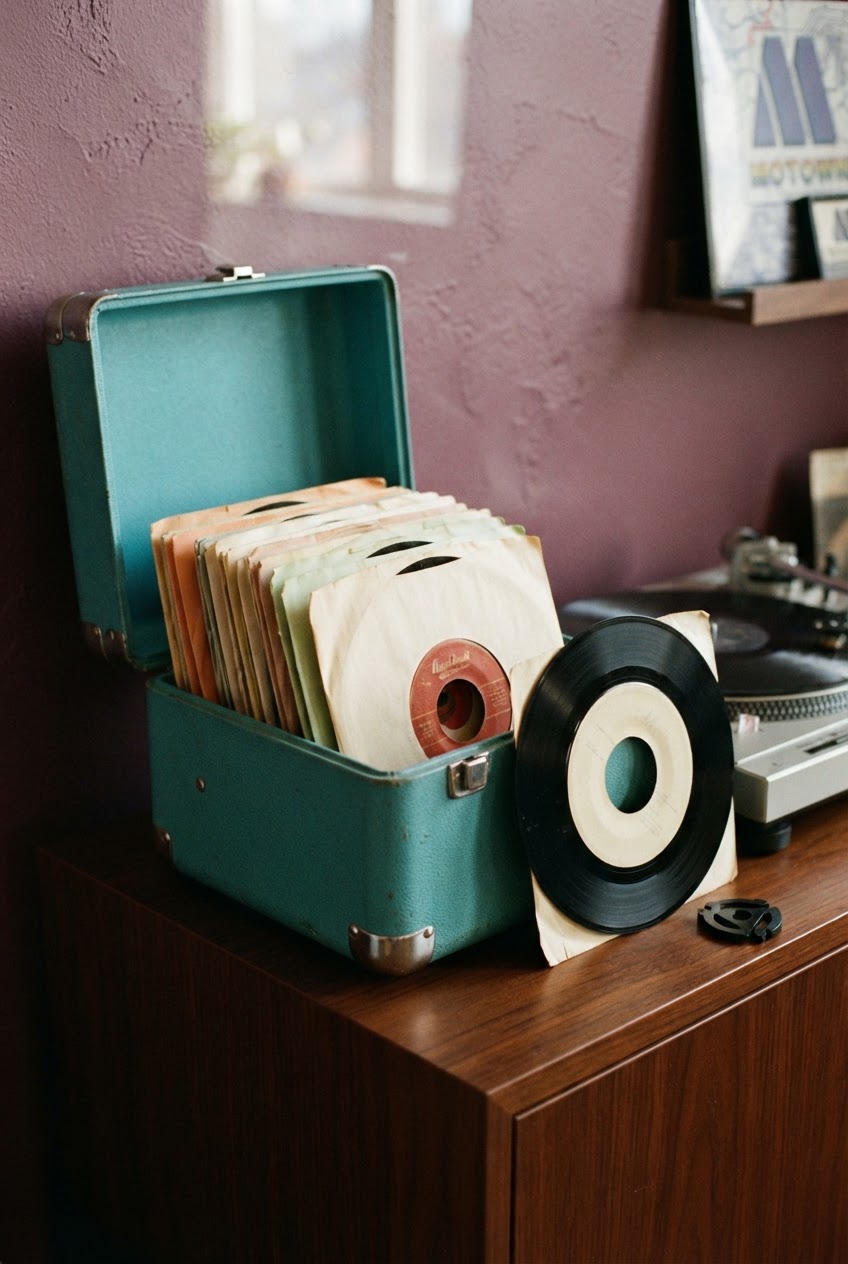
Put a little record carrier beside the turntable and give the front slot to the single you keep meaning to play. Eight to twelve 45s is a good starting rotation. You can see the picture sleeves, flip through them with one hand and change the lineup when you feel like hearing something else.
As an Amazon Associate I earn from qualifying purchases. The room image is an AI-generated styling illustration.
Take a cardboard sleeve to the thrift store
Seven inches tells you the diameter of the record. The case also has to accommodate the paper sleeve and any outer protector you use. Trace your tallest sleeved single onto a piece of cereal-box cardboard. If a different sleeve is wider, use its width for the template. Slip the cutout into a case and gently close the lid. A bent corner tells you where the lid is pinching.
Buying online? Ask for the usable width inside the case and the height with the lid shut. The GPO catalogue is a handy secondhand reference. GPO made similar-looking carriers in two sizes and listed its 7-inch version for 20–25 singles. A photo of the closed case alone can make the sizes hard to tell apart.
Check how it feels to pull one record
On a vintage case, test the empty handle, hinges and latch, then feel along the lining for loose edges that might snag a sleeve. At home, pull one record from the middle. If its neighbors come up with it, take a few out. Set the case where its open lid clears the turntable dust cover.
To shop by format, compare carrying cases for 7-inch singles on Amazon. Have the seller’s inside measurements and your sleeve template handy.